Foren Aktuelles Erstellen Mitglieder Anmelden

Allerlei Technikdiskussionen

Benutzer, welche sich diesen Thread anschauen:

Also die Präsentation ist wirklich auf einer Stufe mit den ganz schlechten e3 Präsentationen. Das Problem bei dieser ist nur, dass sie viel länger geht. :D
 
So mies find ich sie gar nicht. Eigentlich recht interessant, nur den Games Part hätten sie sich sparen können.
Das Video von DICE ist zB wirklich ziemlich kewl. Genauso wie der Audio Part von GenAudio, den ich sehr spannend fand.

Ist aber halt auch keine massentaugliche Präsentation, sondern mehr eine Tech Konferenz. Das lässt sich kein Stück mit den Präsentationen einer E3 vergleichen. Da gibts keine tolle, durchgestylte Inszenierung und nicht einmal wirklich geübte bzw. professionelle Präsentatoren.
 
Klar. Ich spreche jetzt als Internet-Zuschauer. Ne Stunde Verspätung, 7.1 Sound Vorstellung während der Stream eben nur Stereo ausgibt, Star Citizen Hangar Modul ewig lange Demo. Und jetzt ne Powerpoint Präsentation während einer Powerpoint Präsentation, mit der Ankündigung, dass wir darauf schon ewig gewartet hätten. Dann noch, dass es wegen den Next-Gen Konsolen interessant wäre und eigentlich geht es nur um die Engine und wie man auf nem PC da das beste rausholt.
 
Mantle so far...

AMD unveils revolutionary 'Mantle' API to optimize GPU performance
eJMk1vq.jpg


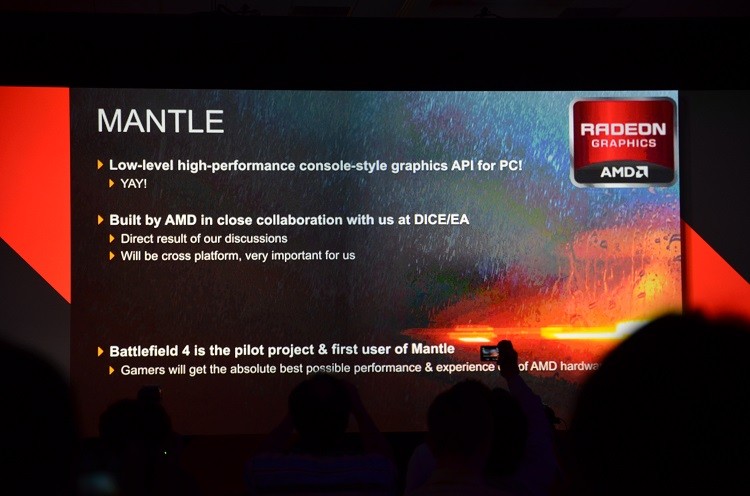
At AMD's GPU14 Tech Day event in Hawaii, alongside the brand new Radeon R9 290X GPU, the company has also unveiled a new development model called 'Mantle'. As a combination of both API specifications and GPU drivers, Mantle will allow developers to fully unlock the graphics potential of the GCN 2.0 architecture of the new Radeon series, through low-level high-performance drivers.

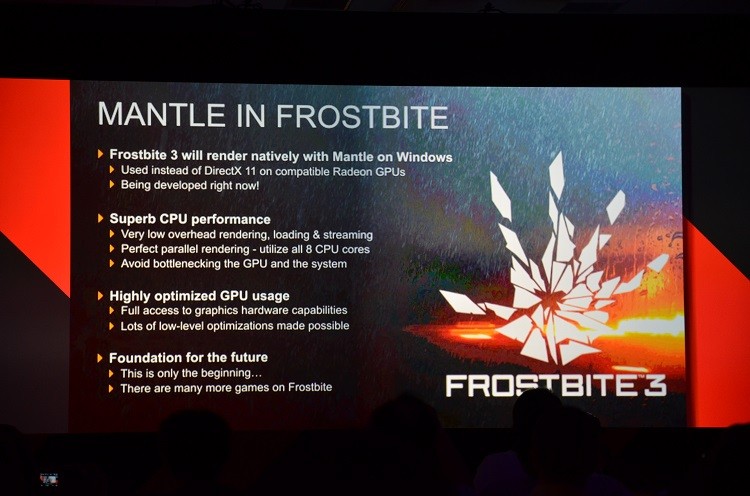
Battlefield 4 will be the first title to use Mantle, with the technology coming through a free update in December. Mantle brings greater control of the GPU and CPU to game developers, especially in the memory department, which will allow games to harness the full potential of graphics cards. This model will be more similar to what is found on consoles, where developers have huge control over what hardware they use in their games.
WlDUC22.jpg


While the technology is still in early stages, EA says it will allow PC game developers to harness even more graphics power than ever before. Where possible, Mantle will be used instead of DirectX 11 on compatible AMD hardware, although it's still compatible with other rendering APIs. AMD claims Mantle enables nine times more draw calls per second than other APIs, which is a huge increase in performance.

We've been told at the GPU14 Tech Day event that the Mantle API is open, so theoretically Nvidia could purpose the technology in their GPUs. It should also make cross-development between PC and console games a lot easier, and also more incredible for those with a high-performance AMD GPU.

More information on Mantle will be available at the AMD Developer Summit in November.

http://www.techspot.com/news/54134-amd-launches-mantle-api-to-optimize-pc-gpu-performance.html


AMD reveals the Radeon R9 290X alongside new R7 and R9 GPU lines

2013-09-25_04-13-46.jpg


For the last few days, AMD has been throwing their GPU14 Tech Day event in Hawaii, gearing tech media up for the reveal of their next-generation graphics card. We've seen a few leaks surrounding this card, known as the Radeon R9 290X, and AMD has been pushing this announcement as the next big thing for PC gamers. But not until today have we officially heard the specifics relating to this graphics card, and what it will mean for the gaming market.

2013-09-25_04-16-48.jpg


First up we have photos of the actual card, as seen at Tuesday's reception on the USS Missouri, accompanied by EA Dice for Battlefield 4. It's fairly standard in designs as far as we've seen recently for GPUs, with AMD once again opting for an air cooler at the end of the card that pushes air across the GPU core itself. The front panel sees dual-DVI ports, plus a HDMI port and a DisplayPort, and for power there's an 8+6pin PCIe power port.

2013-09-25_04-20-45.jpg


Perhaps most interesting, though, is the lack of a CrossFire port a long the top of the card. Speculation at the event is that AMD will be using PCI Express 3.0 for connectivity between two GPUs, ditching their proprietary connector that added extra bandwidth. PCIe 3.0 is found already in many modern motherboards, and it supports 120 GT/s (15.8 GB/s) transfers in each direction through a 16x slot, compared to 80 GT/s (8 GB/s) through PCIe 2.0. This extra bandwidth should allow it to ditch the connector at the top, instead pushing the necessary frame information through PCIe 3.0.

2013-09-25_15-23-59.jpg


There's 4GB of memory aboard this card, 5 TFLOPS of computer power, 300 GB/s of memory bandwidth, and the ability to process 4 billion triangles per second. The GPU itself packs a whopping 6 billion transistors, and is built to support 4K Ultra HD resolutions.

The R9 290X will be available alongside Battlefield 4 in an exclusive bundle, although prices and a launch window have yet to be announced.

2013-09-25_15-49-54.jpg


AMD also launched new R7 and R9 card lines, right from low-budget cards to enthusiast GPUs at many price points. The R7 250 is a <$89 budget card with 1GB of GDDR5 memory, the R7 260X is a 2GB card for $139, the R9 270X is a 2GB card for $199, and there will also be an R9 280X with 3GB of memory for $299. We also heard about an R9 290 later in the demonstration, but this wasn't detailed.

To support 4K displays, AMD has proposed a new VESA standard that will be embedded in 4K displays, allowing them to work out of the box with various devices. It will be supported in the Catalyst Control Panel, and should resolve issues with screen tearing at high-resolutions.

2013-09-25_15-34-16.jpg


AMD TrueAudio will be a major part of Graphics Core Next 2.0-based graphics cards, available in the R9 290X, R9 290 and R7 260X. AMD is calling this technology a revolution for audio designers and game developers, similar to programmable shaders. We listened an "AstoundSound" demo at the GPU14 tech day from GenAudio, and it sounded absolutely incredible in 7.1 surround sound.

TrueAudio appears to be dedicated DSP technology on AMD's latest chips, which plugins can access to reduce GPU and CPU load. It was mentioned that certain plugins, such as AstoundSound, will be available for PC, Xbox One and PlayStation developers, enhancing how we hear in-game sounds. TrueAudio will help greatly with reverberation technology - normally a CPU and memory intense task - as audio tasks can be offloaded to the DSP.
http://www.techspot.com/news/54124-amd-reveals-the-radeon-r9-290x-alongside-new-r7-and-r9-gpu-lines.html
 
Ja, mir sind da vorhin auch beinahe die Augen rausgefallen. :D

Beim Technical Director der Frostbite Engine von DICE hat mans richtig in den Augen glänzen sehen. Wie ein kleines Kind unterm Weihnachtsbaum, als er davon erzählt hat.
 
Das heißt also mit Mantle kann man das volle Potential eines GPU ausnutzen, also z.B.: die vollen 5 TF? Und wieso ging das bisher noch nicht? (Kenn mich damit nicht so aus...)
 
Copado schrieb:
Das heißt also mit Mantle kann man das volle Potential eines GPU ausnutzen, also z.B.: die vollen 5 TF? Und wieso ging das bisher noch nicht? (Kenn mich damit nicht so aus...)

Das liegt daran dass auf dem PC Sektor bisher hauptsächlich mit grafischen High-Level Schnittstellen (wie eben Direct3D) gearbeitet wurde, die sich auf jede gängige Hardware aufsetzen lassen. Bei einer High-Level Grafik API wird nie direkt mit dem GPU gesprochen, sondern stets von der High-Level API übersetzt. Ist eine einfache Sache für die Entwickler, aber dafür haben sie kaum Kontrolle über die darunter liegende Hardware und können diese entsprechend auch nicht wirklich an ihren eigentlichen Möglichkeiten ausreizen, weshalb verfügbare Performance auf der Strecke bleibt.

Für die Konsolen ist dieses Arbeiten auf niedriger Ebene charakteristisch, aufgrund der geschlossenen Hardware, weshalb im Vergleich zum PC aus uralt Hardware noch so viel herausgeholt werden kann. Natürlich kann man auch dort mit High Level APIs arbeiten (wie es zum Beispiel eigentlich alle Launch Titel der Next Gen tun), aber man wird das volle Potential der Hardware damit nie ausnützen.

Mantle hingegen ist nun eine Low-Level Graphics API die für den PC entworfen wurde und mit der sich bisher unterstützte GPUs direkt ansprechen lassen. Beginnend mit AMDs GCN 2.0 Architektur. Da es sich aber scheinbar um keine proprietäre Schnittstelle, sondern um ein Cross-Plattform-Projekt handelt, könnte sich ebenso Nvidia mit ihren GPUs anschließen.

Das Pilot-Projekt für Mantle, welches vor allem in Zusammenarbeit mit DICE/EA entstand, wird Battlefield 4 sein.
 
Seh ich nichtmals so schwarz.

Da die PS4 (One auch?) auch eine Low Level-API hat, wird man auch da neue Möglichkeiten finden. Dies soll ja sogar relativ einfach sein.

Für uns Konsoleros geht es letztlich doch nur darum, dass das Maximum aus der Konsolen-Hardware geholt wird. Wie gross nun der Unterschied zum PC ist, ist mir persönlich zumindest die ersten Jahre noch egal. Der PC wird immer vorne liegen.

PC'ler haben aber nun vielleicht endlich mal das Glück, dass die neuen Engines und APIs die vorhandene Hardware wirklich nutzen, ohne auf die Konsolen "Rücksicht" nehmen zu müssen.
 
Gibt auch nichts zum Schwarzmalen. Für die Konsolen bleibt alles beim Alten, außer dass sich dadurch auch, laut dem Technical Director der Frostbite Engine, PC-Konsolen-Ports leichter realisieren lassen.

Bedeutet für die Konsolen nur eins: Die bereits von den Specs her (im Vergleich zu aktueller PC Hardware) etwas schwachbrüstigen Konsolen könnten noch mehr zurückfallen. Vorausgesetzt Mantle erhält überhaupt breiteren Support durch die Entwickler. Bisher, da das Projekt gerade zum ersten Mal der Öffentlichkeit präsentiert wurde, weiß man ja nur von DICE/EA, dass sie auf den Zug aufspringen, da sie auch an der Entwicklung beteiligt waren.
 
Wenn das Konzept der Steambox aufgeht,
entsteht dadurch automatisch eine direkte Konkurrenz zu den Konsolen.

Mit SteamOS ein einheitliches Betriebssystem, das auf TVs optimiert ist,
Controller Support + deutlich stärkere Hardware.
Wenn dazu noch die aktuellen Treiber und Update/Patches im Hintergrund installiert werden
(wovon ich ausgehe), ist fast kein technisches Know-how mehr notwendig
und damit ist das ganze auch für die breite Masse interessant.

Aber natürlich muss sich das ganze noch beweisen!

Der Vorteil könnte sein, das sich durch das Konzept und die individuelle Anpassung der Hardware,
auch die Technik wieder rasanter weiterentwickelt, da die Konsolen nicht im Weg stehen.

Für die Konsolen(Hersteller) würde das bedeuten, das sie Alleinstellungsmerkmale schaffen müssen.
Wenn das nicht über die Grafik geht, dann über neue Ideen und innovative Spiele!
 
@ Trayal

Wenn EA die Technologie mitmacht und sie auch wirklich etwas bringt, dann werden mittelfristig die Anderen auch nachziehen, da bin ich mir relativ sicher.

@ SteamBox

Das Konzept einer SteamBox ist sicher sehr reizvoll. Die Krux daran könnte der Preis werden. Wenn die billigste Kiste nachher um die 800$/€ kostet, dann wird es schwer in die Konsolen-Domäne einzudringen. Dann werden eher PC-Spieler zur SteamBox wechseln.
 
Da bin ich ja mal gespannt was diese skizzierte Wundertüte bewirken kann, insbesondere unter der Prämisse der polyvalenten Hardwarebasis der PC-Gefilden, die den geschlossenen Systemen der Konsolen um Meilen hinterherhinken. Und Battlefield war ja schon immer äusserst ressourcenschonend, mal schauen was Teil 4 sich nun nehmen wird. :gerri:
 
Das ganze ist schon sehr interessant... Erinnert mich an die Glide-API :puschel:

Ganz in den bereich der Effizienz von Konsolen-code wird man wohl dennoch nicht kommen (Hardware-segmentierung; "langsame" Schnittstellen zwischen CPU und GPU; Windows etc.), aber ein riesen Schritt vorwärts dürfte das, wenn korrekt umgesetzt, tatsächlich sein. Da würde dann selbst ne 500€ Steambox den Next Gen Konsolen auf und davon laufen.

Bleibt halt abzuwarten wie effizient AMD diese Schnittstelle schreibt, updated und den darunter liegenden Treiber optimiert... Auch wie einfach die Portierung von DirectX auf diese API läuft bzw. wie viele Studios sich das antun wollen. PC-Gaming ist zwar in einer erneuten Blüte, aber dennoch n gutes Stück hinter Konsolengaming was profitable Umsätze angeht... zumindest hab ich so das Gefühl.
 
Zurück
Oben
