
App installieren
So wird die App in iOS installiert
Folge dem Video um zu sehen, wie unsere Website als Web-App auf dem Startbildschirm installiert werden kann.
Anmerkung: Diese Funktion ist in einigen Browsern möglicherweise nicht verfügbar.
Du verwendest einen veralteten Browser. Es ist möglich, dass diese oder andere Websites nicht korrekt angezeigt werden.
Du solltest ein Upgrade durchführen oder einen alternativen Browser verwenden.
Du solltest ein Upgrade durchführen oder einen alternativen Browser verwenden.
Benutzer, welche sich diesen Thread anschauen:
Gesamt: 1 (Mitglieder: 0, Gäste: 1)


Einige? Tausende.War nicht mal die Rede von musk, das einige Atombomben den Planeten auch erwärmen würden oder so
Und selbst dann würde es Jahrhunderte, eher ein Jahrtausend + dauern bis sich eine Atmosphäre bildet.
Laut Wissenschaftlern würde die Temperatur aber selbst dann nur auf -50°C steigen und das bei einem (wür Menschen) viel zu niedrigen druck um die Luft dann auch Atmen zu können.
Und dazu kommt das es ja einen Grund hat warum der Mars keine Atmosphäre hat (zu wenig Masse und kein Magnetfeld). Man müsste als dauerhaft dafür sorgen das Gase freigelassen werden die die ersetzen die in den Weltraum entweichen.
Also kurzum, wir haben aktuell noch nicht mal theoretische Technologien die uns das ermöglichen könnten.


War nicht mal die Rede von musk, das einige Atombomben den Planeten auch erwärmen würden oder so
Scheint wohl zu stimmen, wurde hier auf Planet Erde ja bereits getestet.

Tobi23TS
Benutzertitte
Wenn jemand es hinbekommt nen planeten zu erwärmen, dann die menschheit. Oder greta? 
Aber mal ernsthaft, wenn man atombomben zündet, wäre der planet doch eh erstmal unbewohnbar. Keine ahnung, warum man den mars überhaupt transformieren will. Wäre es nicht sinnvoller dort zu versuchen ne zwischenstation zu bauen, von der aus man weiterreisen könnte, im falle das die technik mal soweit ist?
Aber mal ernsthaft, wenn man atombomben zündet, wäre der planet doch eh erstmal unbewohnbar. Keine ahnung, warum man den mars überhaupt transformieren will. Wäre es nicht sinnvoller dort zu versuchen ne zwischenstation zu bauen, von der aus man weiterreisen könnte, im falle das die technik mal soweit ist?


XettMan
Captain Slow
Ja, das ist so. Und für ein Lichtteilchen vergeht gar keine Zeit.
Ist das echt so?
Wenn ja.....:mindblow:
Das ist am Start praktisch schon da. Überall auf seinem Weg gleichzeitig.
Das Photon von der Sonne in gerris Photovoltaikpanel ist gleichzeitig noch in der Sonne und schon bei gerri. Zumindest im Bezugssystem des Photons. Für uns sind da schon über 8 Minuten vergangen.
Testflug Nr.7 nächste Woche mit der neuesten Generation des Starships:
• Ship's forward flaps have been reduced in size and shifted towards the vehicle tip and away from the heat shield, significantly reducing their exposure to reentry heating while simplifying the underlying mechanisms and protective tiling
• Redesigns to the propulsion system, including a 25% increase in propellant volume, the vacuum jacketing of feedlines, a new fuel feedline system for the vehicle’s Raptor vacuum engines, and an improved propulsion avionics module controlling vehicle valves and reading sensors
• Ship’s heat shield will use the latest generation tiles and includes a backup layer to protect from missing or damaged tiles
• The vehicle’s avionics underwent a complete redesign, adding additional capability and redundancy for increasingly complex missions like propellant transfer and ship return to launch site.
• Avionics upgrades include a more powerful flight computer, integrated antennas which combine Starlink, GNSS, and backup RF communication functions into each unit, redesigned inertial navigation and star tracking sensors, integrated smart batteries and power units that distribute data and 2.7MW of power across the ship to 21 high-voltage actuators, and an increase to more than 30 vehicle cameras giving engineers insight into hardware performance across the vehicle during flight.
• While in space, Starship will deploy 10 Starlink simulators, similar in size and weight to next-generation Starlink satellites as the first exercise of a satellite deploy mission. The Starlink simulators will be on the same suborbital trajectory as Starship, with splashdown targeted in the Indian Ocean. A relight of a single Raptor engine while in space is also planned
• On Starship’s upper stage, a significant number of tiles will be removed to stress-test vulnerable areas across the vehicle
• Multiple metallic tile options, including one with active cooling, will test alternative materials for protecting Starship during reentry.
• Several radar sensors will be tested on the tower chopsticks with the goal of increasing the accuracy when measuring distances between the chopsticks and a returning vehicle during catch
• The Super Heavy booster will utilize flight proven hardware for the first time, reusing a Raptor engine from the booster launched and returned on Starship’s fifth flight test.
• Hardware upgrades to the launch and catch tower will increase reliability for booster catch, including protections to the sensors on the tower chopsticks that were damaged at launch and resulted in the booster offshore divert on Starship’s previous flight test.
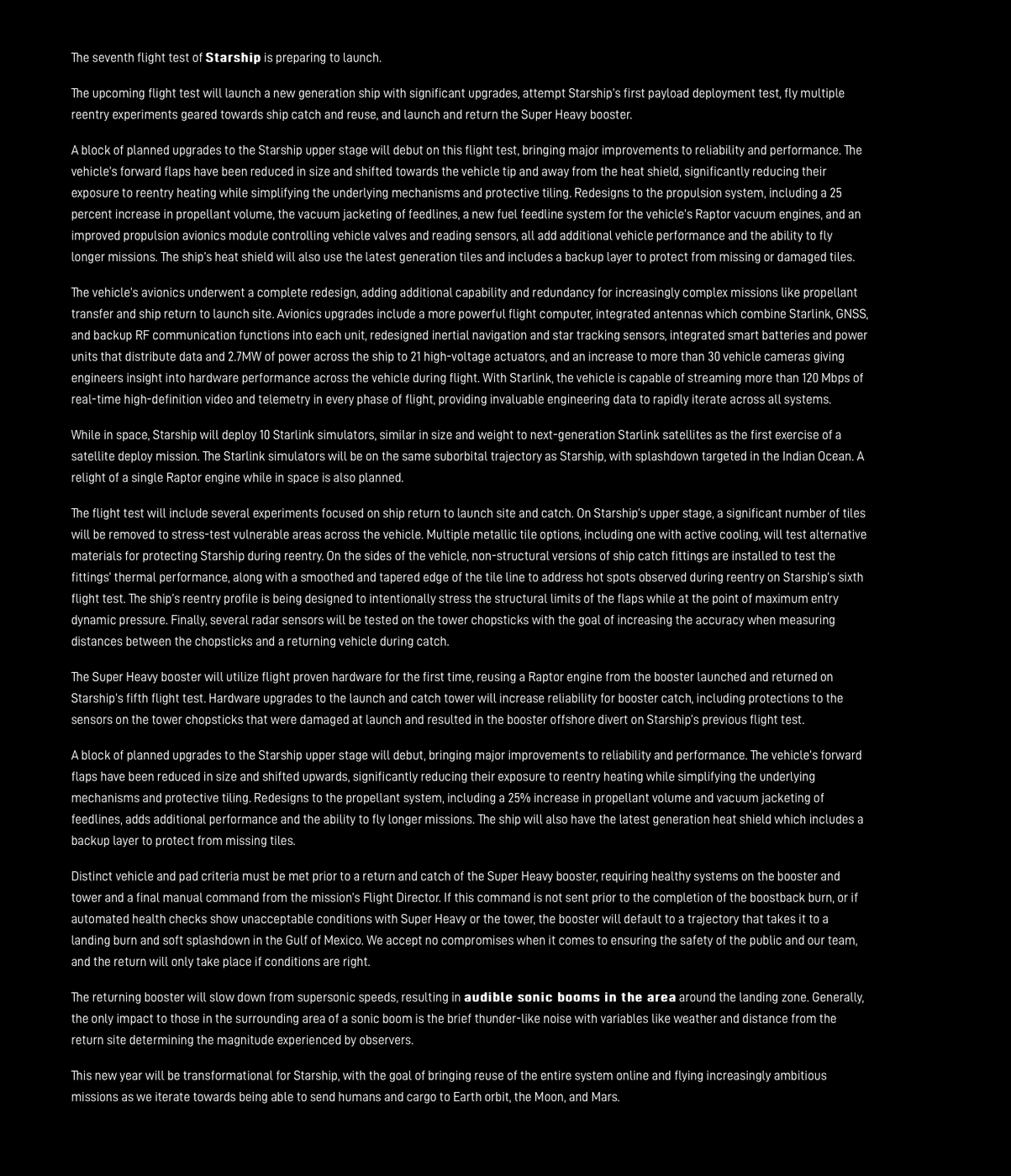
• Ship's forward flaps have been reduced in size and shifted towards the vehicle tip and away from the heat shield, significantly reducing their exposure to reentry heating while simplifying the underlying mechanisms and protective tiling
• Redesigns to the propulsion system, including a 25% increase in propellant volume, the vacuum jacketing of feedlines, a new fuel feedline system for the vehicle’s Raptor vacuum engines, and an improved propulsion avionics module controlling vehicle valves and reading sensors
• Ship’s heat shield will use the latest generation tiles and includes a backup layer to protect from missing or damaged tiles
• The vehicle’s avionics underwent a complete redesign, adding additional capability and redundancy for increasingly complex missions like propellant transfer and ship return to launch site.
• Avionics upgrades include a more powerful flight computer, integrated antennas which combine Starlink, GNSS, and backup RF communication functions into each unit, redesigned inertial navigation and star tracking sensors, integrated smart batteries and power units that distribute data and 2.7MW of power across the ship to 21 high-voltage actuators, and an increase to more than 30 vehicle cameras giving engineers insight into hardware performance across the vehicle during flight.
• While in space, Starship will deploy 10 Starlink simulators, similar in size and weight to next-generation Starlink satellites as the first exercise of a satellite deploy mission. The Starlink simulators will be on the same suborbital trajectory as Starship, with splashdown targeted in the Indian Ocean. A relight of a single Raptor engine while in space is also planned
• On Starship’s upper stage, a significant number of tiles will be removed to stress-test vulnerable areas across the vehicle
• Multiple metallic tile options, including one with active cooling, will test alternative materials for protecting Starship during reentry.
• Several radar sensors will be tested on the tower chopsticks with the goal of increasing the accuracy when measuring distances between the chopsticks and a returning vehicle during catch
• The Super Heavy booster will utilize flight proven hardware for the first time, reusing a Raptor engine from the booster launched and returned on Starship’s fifth flight test.
• Hardware upgrades to the launch and catch tower will increase reliability for booster catch, including protections to the sensors on the tower chopsticks that were damaged at launch and resulted in the booster offshore divert on Starship’s previous flight test.

Ähnliche Themen
G
-
Gelöschte Mitglieder 5700
- Antworten
- 46
- Aufrufe
- 3K
