G
Gelöschte Mitglieder 213
Gast
glaub zu jedem soulsborne ableger hatten wir 1:1 die selbe news, um einfach den "alten kern" zu beruhigen und trotzdem finden es dann einige am ende dann doch wieder "deutlich einfacher als xy". 

Folge dem Video um zu sehen, wie unsere Website als Web-App auf dem Startbildschirm installiert werden kann.
Anmerkung: Diese Funktion ist in einigen Browsern möglicherweise nicht verfügbar.
Viel mehr unterstreicht er einfach nur das was er ohnehin sagt. "Für jeden was dabei"
glaub zu jedem soulsborne ableger hatten wir 1:1 die selbe news, um einfach den "alten kern" zu beruhigen und trotzdem finden es dann einige am ende dann doch wieder "deutlich einfacher als xy".
Wobei ich glaube, dass der Schwierigkeitsgrad tatsächlich mit jedem Soulsborne-Game angestiegen ist. Habe ich jetzt besonders beim Demon's Souls und Dark Souls Rerun gemerkt wie leicht die Spiele sind im Vergleich zu Bloodborne und Dark Souls 3.
Aber mit Genrekenntnis stirbt man natürlich deutlich seltener.

One of thing a lot of fans loved about the Souls series, however, was its almost archaeological approach to storytelling, the way the games didn't rely on cutscenes to dish out chunks of exposition but instead left clues hidden throughout the world for the most diligent players to piece together. Will a more character-driven story mean a more straightforward narrative? "It's a character-driven story this time, but it's not a story-driven game," Miyazaki said. "The player isn't going to be led down one linear path and have the story spoon-fed to them by many many cutscenes or anything like that. That aspect of From Software's previous games, of gradually picking the pieces up of a fragmented story and building those layers, building that depth, figuring things out for yourself, that's still very much intact in this game." The same goes for its physical layout - Miyazaki says Sekiro will be like Dark Souls 1 in the way that it interconnects, with multiple paths between each area - "with some exceptions." Players will also have choice in the order they complete the game in, From confirmed.
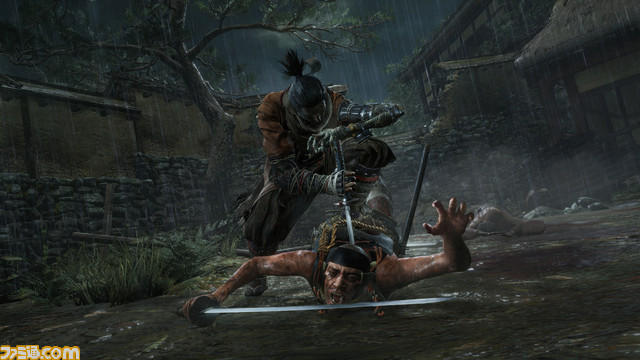
"There are some tools that let you directly attack enemies, ones that function as weapons like the Loaded Axe, and then there are other weapons of 'accentuated taste,' and utility-based tools like the Iron-Gripped Fan that is primarily used for defence," Miyazaki told us. There are also Shuriken, which can strike enemies from afar. You can follow that particular move up with a sword dash combo, which can allow you to close gaps very quickly. All this adds up to what looks like a satisfyingly complex system, exactly the kind you'd expect from Miyazaki and the Souls team. And yet, it is definitely different. It's akin to Bloodborne's more overtly offensive Trick Weapon and gun combo, with players using primarily a katana ("and there are several sword styles associated with that," Miyazaki says) and the Shinobi Prosthetic plus the wide variety of tools that come with it.
The enemies you'll use these skills against seem suitably varied and, most importantly, challenging. There are heavily armoured samurai generals, hard-hitting giants, snipers, and creepy old ladies who will alert other enemies in the area unless you take them out first. One particular mob of enemies caused the From Software developer playing to die and restart several times - Sekiro is punishing to those that make mistakes. "The intention is the player will die a lot," Miyazaki confirmed. "That is because of the concept of the ninja protagonist at its core; as a ninja you're a little less equipped than the average samurai or knight, you're always at death's door. We want every battle to feel intense - we want players to feel that risk and trepidation associated with battle and fighting toe to toe with these enemies. And in order to do that, the player has to die a lot. But when they die and respawn and die again, and then retry, that doesn't feel good. So, we needed something to address that, and that became the resurrection system."
This was not created in order to make the player feel numb to death or make the player unafraid of death. We want them to still have 'the stench of death' present in every single encounter, if you will, so this is something that will be tuned and tweaked as we go forward. It's going to have its own restrictions and limitations, and we're going to have our own death penalty that fits this concept." From wouldn't go into more detail on what Sekiro's death penalty might look like, but it did say that "something different is planned." And, on the subject of healing, From would only say that though the build we saw is still in progress and pretty much everything is open to change, the way healing currently works in Sekiro is similar to Dark Souls' Estus in that "you have a set amount of charges that you can regain, and you can upgrade the amount of charges that you have."
"One thing we're really excited for players to experience are these really tense cat and mouse sequences with these larger than life enemies."
At the end of the tunnel we find ourselves in front of what From is "tentatively" calling a Shinobi Door. "It's opened in a special way, and it represents the fact that there will be secret paths that lead you to unexpected places and secret areas." Passing through this door we find ourselves standing in a beautiful traditional Japanese courtyard at sunset, where almost every surface is glowing red, orange and pink as cherry blossoms fall delicately from the trees. In addition to the gritty, bloody aspect of 1500s Japan, From is keen to represent the country's ancient, natural beauty. Before we can really drink it in, we step forward and initiate a boss fight. A swirling, towering, but undeniably elegant figure called the Corrupted Monk lunges forwards, laughing, grabbing, and clashing swords at a frightening rate - it's immediately clear that timing is crucial to gaining the upper hand here. Once enough damage has been exacted, however, the music becomes frenzied and the entire area becomes bathed in a blinding white light that more or less renders the entire fight in silhouette. It's an unexpected and extremely stylish touch that brings to an end an expectedly stylish demo. The Corrupted Monk was an unmistakably Miyazaki boss fight with a difference, but can we still expect that 'melancholic beauty' and reams of unspoken backstory that the director so loved to bring to the iconic boss battles of Dark Souls? "Of course!" he laughed, "But we hope this will be somewhat different from the Dark Souls approach, you won't just be going up against the big tough enemies - it does depend on the boss room and on the type of boss. There will be certain boss fights and certain larger than life enemies where you can use stealth as a tactical advantage."
https://www.resetera.com/threads/sekiro-sdt-very-detailed-interview.54195/One of the things From is resolute about not borrowing from Dark Souls, however, is any kind of asynchronous multiplayer system - Sekiro will be a purely single-player experience. "We aren't considering a system similar to the messages or any asynchronous system," confirms Miyazaki when asked whether they were ever tempted to put something like that in the game. "That goes back to wanting to do something new; we don't want it to just be a repeat of what we've done before. And also it links nicely to the ninja protagonist - you can explore the map and you can find certain NPCs with certain intel and you can eavesdrop on them. You can find this info about the map, about the world, about the other enemies, about what's going on, about the lore, and you can use that to your advantage or you can use it to piece together various aspects of the story." To be clear, this lack of multiplayer also extends to summoning friends and non-NPC help, too. In previous titles you could summon other players to help you defeat a boss, and you don't have that in Sekiro - you are all by yourself. But, to counter this, there are other options that weren't there before, like stealth and special attacks that you've chosen to upgrade, and by doing so you may be able to figure out a way to defeat something that you weren't able to before. From confirms that Sekiro's progression system has moved away from using stats, saying that "something totally different will be in place," but "that feeling of getting stronger and the fact that you kill enemies to make you stronger is still going to be there." It's not really about finding and equipping armour any more, either - Sekiro will be more focused on how you upgrade, and how you'll find and gain new abilities that make you more powerful.
The move away from multiple classes is perhaps an unexpected one, but it makes sense in the context of From wanting to give players a strictly single-player focused experience. From spoke briefly about how it wanted to see "how far" it could take single player, and when you incorporate multiplayer and in particular multiple classes, it puts some limitations on the design. If you create a Dark Souls boss in a multiplayer, multi-class situation, it has to be designed in such a way that it can be taken down by a magic user, by a knight, or any combination of many different builds. So, From has made a decision in Sekiro to have just one class - ninja - and focus its enemy design to test that class specifically. In doing so, From says, it can increase the breadth of options that players have and experiment with how bosses can present new challenges. "It relates back to what we were saying about the ninja, and how they have a lot of things at their disposal and they have to master every part of their arsenal in order to confront these different situations," explained Miyazaki. "So we feel that this time, there are a lot of tools that we have prepared for the player, of various skill levels, so that if they want to run in there head-on, they can do that and clash sword-to-sword. If they want to use the Shinobi Prosthetic to outsmart their opponents and find that one weakness, they can do that. If they want to use stealth to circumnavigate an encounter and get the drop on the enemy and then engage, they can do that too, so there are a lot of ways they can approach battle - it's not just about being this high-reaction, twitch-based gamer."
PlayStation.Blog: Sekiro is set during the late 1500s in Sengoku-era Japan. What led you in that direction?
Hidetaka Miyazaki: If we’re going to do something with ninjas, there are two key areas that are relevant: the Edo period and the Sengoku period. For context, the Sengoku period was a bit earlier than the Edo period.
We ended up landing on the Sengoku period [because it] was dirtier — it was grittier and bloodier. It had more of a feel of the type of world we’d want to create…
A good fit for a FromSoftware game!
The other reason we landed on this period is because [it still seems] “medieval,” vs the Edo period, which feels more modern. In my mind, it felt more believable to see something mystical or having to do with the presence of gods in the Sengoku period.
Another thing is that it’s set at the end of the Sengoku period. The reason for that is, in my opinion, there’s a nuance — a beauty — in the finality of something coming to an end. That fits our artistic sense, and we wanted to express that.
On that note, your games often deal with death as a theme. What impact will death have on the story and gameplay of Sekiro?
Probably the best way to cover that question is to directly address the fact that there is resurrection in the game.
My idea of a ninja fighting rather than, say, a knight fighting, is that ninjas can’t take a lot of damage. They’re taking a huge risk, they’re very vulnerable while they’re fighting. It’s this idea of fighting on the edge, it’s a risky situation where if you screw up by a hair’s breadth, it’s over. With a knight, there’s more back and forth, there’s armor and all that. The idea of that type of fighting is where the idea for resurrection came from.
With that image for the combat, that it’s risky, a slight mistake and you’re dead, if you had to go back every time you die and walk back to where you were, the tempo of the game would not feel very good. The idea of resurrection is that it helps the flow of the game. Yes, you have this battle, but you don’t necessarily need to go back every time you die, this helps to balance that out and allows for that riskier “edge of the knife” type gameplay.
It’s also related to the game’s story. It’s related to the mystery surrounding the main character as well as the young lord. Resurrection will have something to do with them.
One of the general concepts for the game is that you can kill ingeniously — a ninja is so resourceful that he can even make use of his own death to gain an advantage. That’s kind of the idea we had.
So, to answer your question, there are three ways death influences Sekiro: for the gameplay purposes of keeping the flow good and being able to have this risky situation, to be able to use it creatively, and also that the story centers around the concept of resurrection.
There’s one thing I’d like to make sure isn’t misunderstood: the resurrection system was notintroduced to make the game easier. If anything, it actually can make the game harder because it allows us to push the edge of risky combat where the player can die at any moment.
So the game’s difficulty was balanced around the idea of knowing the player can die and resurrect?
Yeah, exactly.
Can you speak more about what resurrection entails in Sekiro? How exactly does the mechanic work?
The system itself is not yet 100% final, so we don’t want to say anything that might end up changing. What we can say is that it’s in place to maintain the tempo of the game, and the difficulty of the game will be based around it. Just because you have this resurrection mechanic, it doesn’t mean the player won’t be afraid of death.
Can we talk about the main character’s missing arm, and how it will affect gameplay?
There were two things we really liked about using a ninja, in terms of game design. We’ve always designed stages with verticality in mind, we consider it one of our strengths. What really appealed to us was being able to explore that dynamically — not relying on ladders and other ways to move around these stages, but being able to just ‘boom, I’m there’.
The other thing is that when you’re designing gameplay around a ninja, it’s not like a samurai. With a samurai, you’d go right in with a sword, with a ninja you can sneak around, you can do things that are considered unfair — you can blind guys, you can do stuff that’s not honourable. It was really exciting from a gameplay perspective because it opened up so many options.
So, the two key aspects of this shinobi prosthetic are that you can explore with verticality, and you have a variety of moves that you can use in combat.
There was a desire to have a symbol for the idea that you have a wide variety of things at your disposal. That’s how we came up with the arm. It was a way to put that in a single place. This arm can let you do so many things, you can see that there are wires on it, there are tools on it, it kind of gives you the idea that you have this multi-use feature.
Sekiro feels much faster than, say, a Dark Souls or Bloodborne. Is this more of an action game, or will fans of those series feel at home here?
There are two key things about battle in Sekiro. In combat, one of the key aspects that’s important in this game is the violence of the clashing of swords. The other thing is the verticality and dynamic movement that you’re allowed.
That dynamism is in the combat, as well. There are lots of different ways to approach a battle, such as stealth, or using your arm tools. Attacking from above, for example. Some of your ninja tools can take advantage of an enemy’s weakness, as well. Or, if you want, you can just go straight in with your sword.
There are lots of different things you can do that will help you in battle. The game is designed in such a way that even if you’re not insanely good at the game, you can figure out how to get through it if you think about it and play it smart.
Changing gears, what’s your philosophy when it comes to the idea of “lore” versus “story”? The former being focused on world-building within the game, the other the act of actually telling a story.
There are some aspects of Sekiro that will be different than our previous games, and others that will be similar.
In Sekiro, the story is actually centered around the main character. He’s a character in the story, who exists in this world. Previously we had nameless characters who weren’t as involved. Thanks to making the main character part of the story, the beginning of the game is probably easier to understand than our previous games.
Aside from that, not too much is different. This isn’t a game where you go through one area, kill a boss, watch a cutscene, then the game tells you where to go next. The story trickles in as you’re playing the game, you’ll find things that will give you more information on the world — the lore, if you will — along with actual story information as well. In that way, it’s similar to our previous games.
Is there a particular reason you choose to tell your stories this way? Do you find that it’s a more effective way of storytelling?
I’m a fan of stories that require you to use a little bit of your imagination in order to really understand the whole thing.
When I was young, I used to enjoy reading books that were too hard for me, where I could only read maybe half the kanji, and using my imagination to fill in the gaps. I wanted to see if I could bring that kind of experience to a video game, where you use your imagination to bridge those gaps.
FromSoftware announced two games at E3: Sekiro: Shadows Die Twice, as well as Déraciné for PS VR. Has it been challenging to work on both simultaneously?
Actually, I’m very used to directing multiple titles at once. Armored Core 4 and Demon’s Souls were at the same time, while Bloodborne and Dark Souls 3 were at the same time. This is a pretty normal situation for me, but what wasn’t normal was announcing two games at the same time.
I actually prefer “parallel direction” — directing multiple projects at once. As a creative, if you’re focused on a singular thing all the time it’s easy to get stuck in that mentality. It’s easier to find inspiration when you’re working on multiple things than it is when you’re totally focused on one. I enjoy that.
Any final thoughts?
Sekiro: Shadows Die Twice is a different kind of game. Our previous titles have been action RPGs, this time it’s an action adventure.
There are lots of cool new things that I’m looking forward to fans enjoying. Particularly the new story format, or at least the fact that the main character is a big deal in the story. The new ways to explore the world, and the new way that you’re going to become more and more powerful.
There are lots of aspects from our previous titles that I feel we’ve been able to iterate upon. The dynamic exploration, the violent swordfighting, and the huge number of strategic options. I feel that these are all major steps forward for these mechanics, and I’m really looking forward to fans playing it.




Wir verwenden essentielle Cookies, damit diese Website funktioniert, und optionale Cookies, um den Komfort bei der Nutzung zu verbessern.
Siehe weitere Informationen und konfiguriere deine Einstellungen