G
Gelöschte Mitglieder 565
Gast
Ich kann mich an sowas nicht satt sehen... 

Folge dem Video um zu sehen, wie unsere Website als Web-App auf dem Startbildschirm installiert werden kann.
Anmerkung: Diese Funktion ist in einigen Browsern möglicherweise nicht verfügbar.

Der Anfang des Vids sah für mich wie CGI aus.Krass wie "unecht" das Video teilweise aussieht, gerade der Lichtblitz in der Kamera als die Triebwerke zur Landung zünden.


8 April ist Flight DayBin ja so gespannt

#MarsHelicopter touchdown confirmed! Its 293 million mile (471 million km) journey aboard @NASAPersevere ended with the final drop of 4 inches (10 cm) from the rover's belly to the surface of Mars today. Next milestone? Survive the night. go.nasa.gov/ingenuity

Ja, aber durch den Doppelhub geht es fast noch...
Rotor speed 2400 rpm[1][3]
Blade tip speed <0.7 Mach[20]
Operational time 1 to 5 flights within 30 sols[1][4]
Flight time Up to 90 seconds per flight[1]
Maximum range, flight 50 m (160 ft)[1]
Maximum range, radio 1,000 m (3,300 ft)[15]
Maximum planned altitude 5 m (16 ft)[1]
Maximum speed
Battery capacity 35–40 Wh (130–140 kJ)[5]
Die NASA weiß wie man aus langweiligen Experimenten ne Show macht
Wie kann das Vieh in der dünnen Athmosphäre fliegen? Die Rotoren müssen dann ja ultra performant sein.
The Mars Helicopter, Ingenuity aims to make the first powered flight on another planet when it takes off on Mars. It has now landed and safely checked in with the rover. It should detach and fly within the first 30-60 days of the mission. I learned a lot getting to visit the drone right before it was mounted on the rover at NASA Jet Propulsion Laboratory in Pasadena.
How do you fly in 1% of Earth's atmosphere: Have large rotors (they are 1.2m in diameter) and spin them very fast, around 2500 RPM (5x the speed of a helicopter on Earth).
Plus the aircraft has to be light: The Mars helicopter weighs in at 1.8kg or around the same as a laptop. Every piece had to be stripped down for weight. Instead of using aerogel for insulation, the craft makes use of CO2 gaps between components. Even aerogel was too heavy!
One of the major challenges is surviving the Martian night: Temperatures plunge to -80C to -100C so two thirds of the craft's power is actually used to keep its electronics warm. Only one third is used for flying. The estimated flight time is 90 seconds.
The craft can't be driven remotely, it will have to fly autonomously, using its own sensor suite to determine how to fly. The round trip 20 minute delay with Earth means steering the craft from mission control would be impossible.
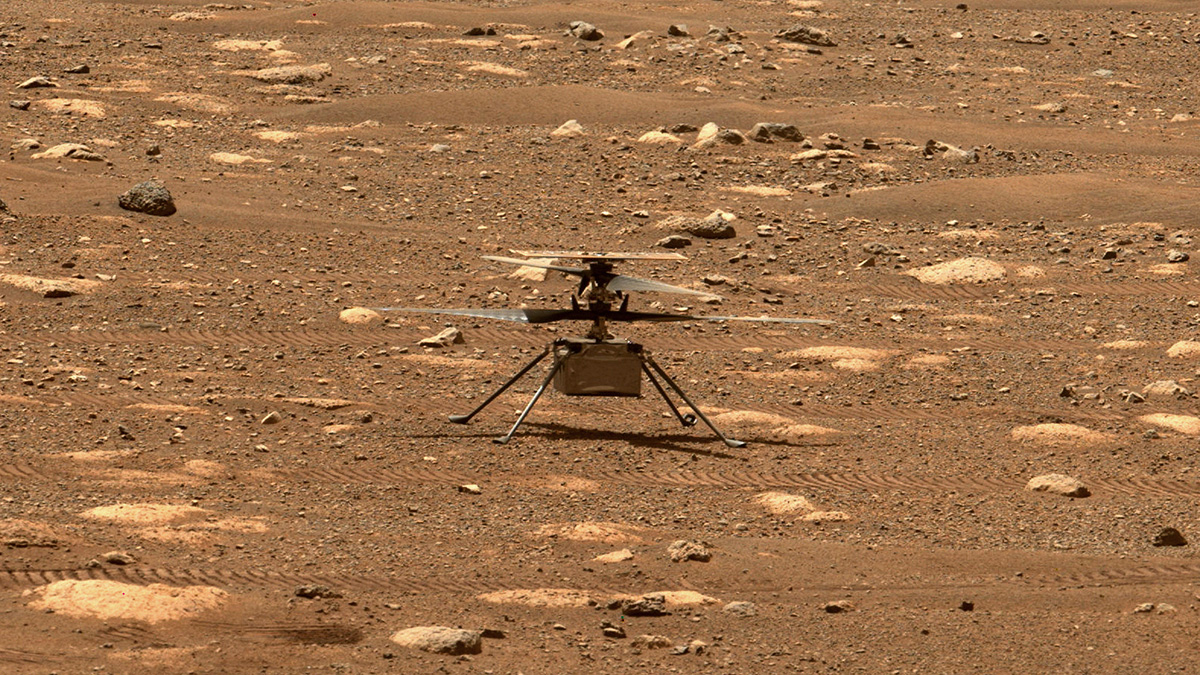

Mars Helicopter Flight Delayed to No Earlier than April 14
Mars Helicopter Flight Delayed to No Earlier than April 14 - NASA Mars

Wir verwenden essentielle Cookies, damit diese Website funktioniert, und optionale Cookies, um den Komfort bei der Nutzung zu verbessern.
Siehe weitere Informationen und konfiguriere deine Einstellungen


